
Reviewed · ECHMIADZIN & ZVARTNOTS TOURS
Group Tour: Echmiadzin Cathedral & churches, Zvartnots Temple
The most striking part of this half-day outing is the contrast between living Armenian worship at Etchmiadzin and the open-air ruins of Zvartnots. You move from active churches, sometimes with liturgy on Sundays, to a seventh-century cathedral that survives mainly through its carved stones and reconstruction drawings.
I like the excellent value at $25, with transport, entry tickets, water, pastries, and a guide included. I also like the compact route: Saint Hripsime, Saint Gayane, Etchmiadzin, and Zvartnots give you a clear introduction to Armenia’s early Christian identity without using up a full day. The main consideration is the large bilingual group, which can reach 49 people and may make explanations, questions, and photographs feel rushed.
Key points to know before you book
- Four major religious sites in about four to five hours: The route packs several of Armenia’s most important churches and ruins into a short morning or afternoon.
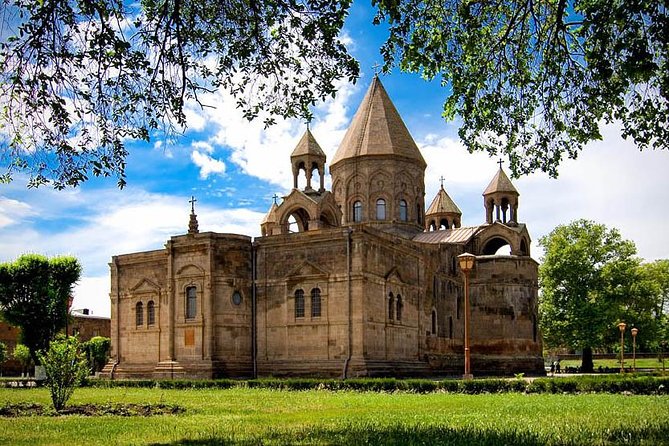
- Etchmiadzin is the emotional center: This is the headquarters of the Armenian Apostolic Church and one of the world’s oldest Christian churches.
- Zvartnots gives you the best sense of architectural ambition: The ruined circular temple once rested on multiple columns and was remarkably complex for the seventh century.
- The tour is bilingual: The guide presents information in English and Russian consecutively, so the format may feel slower than a single-language tour.
- Sunday has a special possibility: You may be able to attend liturgy, but Sunday also tends to bring larger crowds.
- Bring food if you need a proper meal: Water and pastries are included, but lunch is not part of the normal tour.
Why this short trip matters
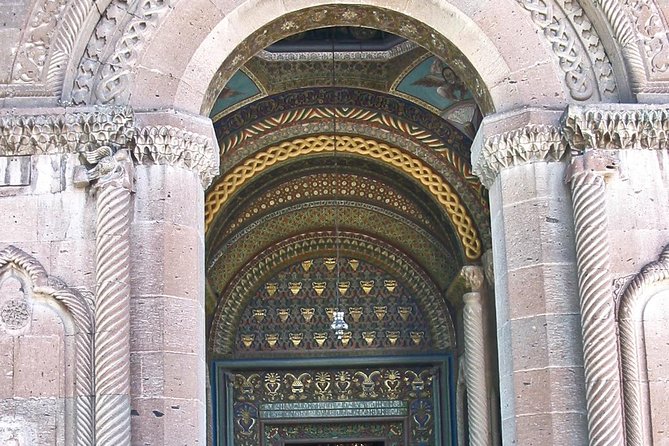
From Yerevan, the road to Echmiadzin opens a window onto Armenia’s place in Christian history. Armenia adopted Christianity as a state religion in the early fourth century, and the churches on this route are not simply old buildings. They are tied to saints, worship, architecture, and the formation of Armenian identity.
The tour begins and ends at Hyur Service on Nalbandyan Street in central Yerevan. You ride in an air-conditioned vehicle with WiFi, passenger and vehicle insurance, and a professional guide. The drive between stops is short enough that the day feels active rather than tiring, though the amount of information can be substantial.
Guides vary by departure. Arpi, Manya, Karine, Gayane, Karen, Tamara, and Tigran are among the guides who have led this route, and the strongest experiences depend partly on how well the guide manages the bilingual format. Guides such as Manya and Gayane have been particularly effective at moving between English and Russian while keeping the group together.
The group can include as many as 49 people. That matters. A large group keeps the price low, but it can also mean waiting for people to gather, standing farther from the guide, or missing a question if you are at the back. One practical complaint concerned a lack of a microphone, so staying close during explanations is wise.
More Echmiadzin and Zvartnots trips:
Saint Hripsime Church and the quiet power of simplicity
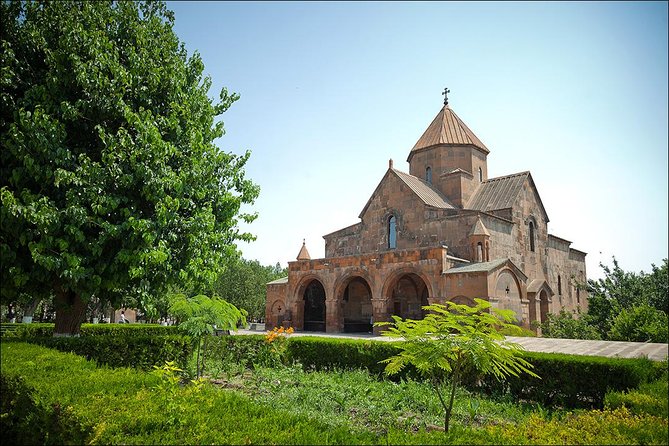
Saint Hripsime is the first major stop, with about 30 minutes to look around. The church is a classic example of Armenian cross-cupola design, a form that uses a central dome and crossing arms to create a strong, balanced interior.
The building is not decorated in a flashy way. Its appeal comes from plain stone, clean lines, and a sense of height. The architecture feels calm and solid, with very little wasted motion. If you have already seen ornate churches elsewhere, this restraint may be a welcome change.
The church is connected to Saint Hripsime, a Christian martyr. Her tomb is in the sacristy, linking the structure to the early Christian story that your guide will explain. The site is part of the UNESCO World Heritage listing that includes the religious monuments of Echmiadzin.
Thirty minutes is enough for a guided introduction and a quick look inside and outside. It is not generous if you want long photographic pauses, careful architectural study, or quiet reflection. Stay alert when the guide gives the meeting time, then use the remaining minutes for your own look.
Saint Gayane, a seventh-century domed basilica
Saint Gayane Church is close to Etchmiadzin Cathedral, and the visit also lasts about 30 minutes. Its dome can be seen against the peaks of Mount Ararat when the weather is clear, giving the approach a memorable setting.
Built in the seventh century, Saint Gayane belongs to the domed-basilica style. It is associated with Saint Gayane, who, according to Armenian tradition, was martyred for preaching Christianity. As at Saint Hripsime, the building’s importance comes from both its design and its place in Armenia’s Christian story.
I find this stop useful because it gives you another example of Armenian church architecture before you reach the main cathedral. The two churches are close in age and tradition, but seeing them one after another helps you notice differences in shape, scale, and interior atmosphere.
Again, the timing is brisk. You may have to choose between listening closely, taking pictures, and simply sitting for a moment. If photography is your main aim, this tour may feel too tightly scheduled. If you want an efficient introduction, the stop works well.
Etchmiadzin Cathedral, the heart of Armenian Christianity
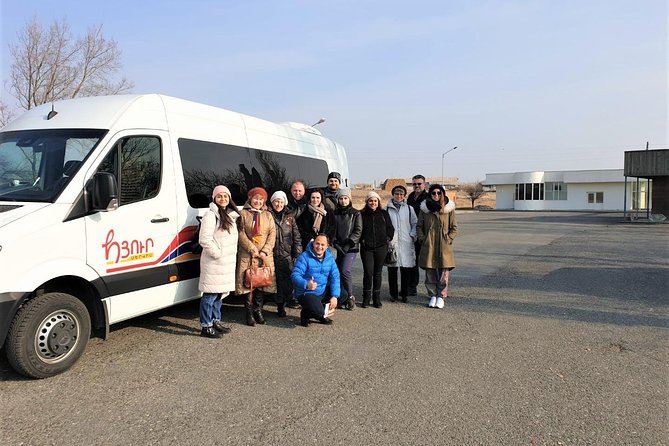
The tour allows about an hour at Etchmiadzin Monastery, the most important stop on the route. Located roughly 20 kilometers from Yerevan, Etchmiadzin is the center of the Armenian Apostolic Church and the residence of the Catholicos, the church’s senior leader.
The cathedral was founded at the beginning of the fourth century. Tradition says Gregory the Illuminator saw an apparition of Jesus Christ in a dream and built the church at that spot. You do not need to accept every detail of the legend to appreciate what the story means: Etchmiadzin represents the beginning of Armenia’s official Christian era.
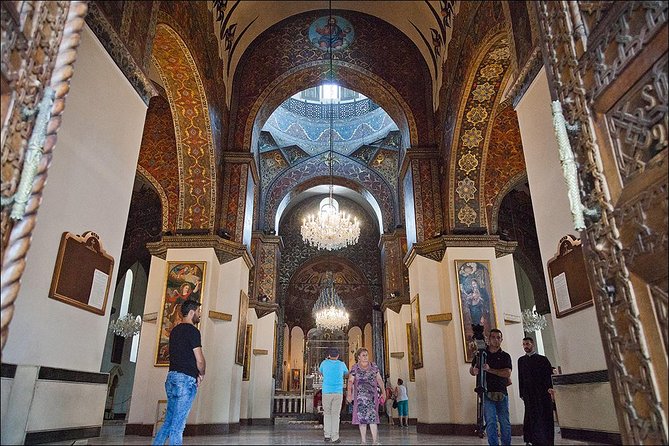
Inside, look for the frescoes connected with the Hovnatanyan family. The cathedral complex also includes the Catholicos’s residence and a theological academy. This is not a frozen monument. It remains a working religious center, which gives the visit more weight than a simple stop at an archaeological site.
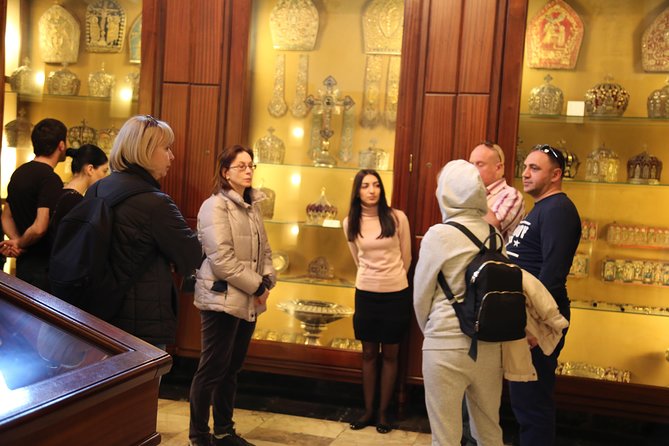
The cathedral’s treasury and museum area can be an important part of the visit, but access is not guaranteed in every situation. One issue raised about a departure was that the museum could not be visited and that this might have been arranged more clearly. If the treasury is open during your visit, it can add a valuable layer to the cathedral experience, but you should not assume every interior area will be available.
On Sundays, there is a chance to participate in liturgy. This can be the most memorable version of the visit, especially if you want to see Armenian Christianity as a living practice rather than only as architecture. The tradeoff is crowding. Sundays can be busy, and a service may limit how freely you can inspect the building.
Dress respectfully and appropriately for a church visit. The operator says the tour runs in all weather, so carry a layer or rain protection as needed. The itinerary includes outdoor walking at the churches and ruins, so comfortable shoes will help.
A few more Yerevan days to weigh up
- Group Tour: Garni, Symphony of Stones, Geghard, Lavash Baking
★ 5.0 · 1,042 reviews - Group Tour: Lake Sevan (Sevanavank), Dilijan (Goshavank, Haghartsin)
★ 5.0 · 1,036 reviews - Group tour: Khor Virap, Noravank, Areni Winery and Cave
★ 5.0 · 651 reviews - Yerevan: Garni, Geghard, Symphony of Stones & Lavash Baking
★ 5.0 · 589 reviews
Zvartnots Temple, ruins with an astonishing design
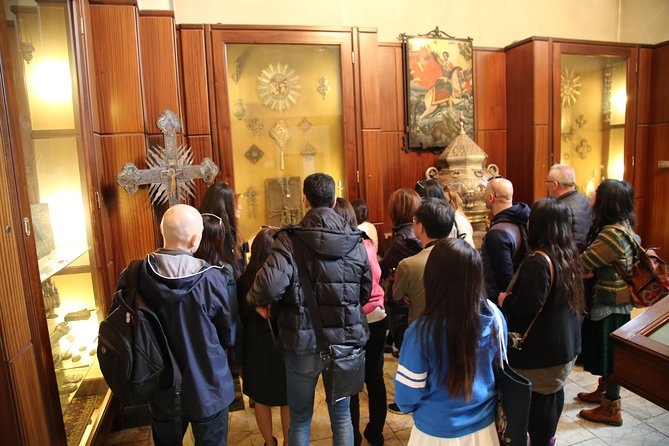
The final major stop is Zvartnots Temple, with about 45 minutes on site. This is where the route shifts from functioning churches to a dramatic archaeological ruin.
Zvartnots was built in the seventh century by Armenian architects who attempted something daring: a large, circular temple supported by several columns. The structure survived until about the tenth century before collapsing, leaving the remains you see today.
What makes Zvartnots special is not only the broken stone. It is the scale of the original plan. Early twentieth-century excavations led architect Toros Toramanyan to propose a reconstruction model so ambitious that specialists found it difficult to believe such a building had existed. A bas-relief at Sainte-Chapelle in Paris later supported his interpretation by showing a version of Zvartnots with Noah’s Ark.
Your guide can help you read the foundations, columns, carvings, and surviving architectural details. Without that explanation, the site may look like a field of scattered stones. With it, you can begin to picture the soaring circular church that once occupied the site.
Zvartnots is also a rewarding place for views. On a clear day, Mount Ararat provides a striking backdrop, though weather and visibility are never guaranteed. Give yourself a few minutes for photographs, but keep an eye on the group’s return time. Forty-five minutes passes quickly.
The temple is included in UNESCO’s World Heritage listing. It is also one of the places where you feel the creative confidence of medieval Armenian builders most clearly. The design was not timid, and the ruins still communicate that ambition.
What the $25 price really covers
At $25 per person, this is a strong-value introduction to the Echmiadzin area. You receive an English and Russian-speaking professional guide, an air-conditioned vehicle, bottled water, pastries, admission tickets, WiFi in the vehicle, and insurance for the vehicle and passengers.
The price is especially useful if you are visiting Yerevan for only a few days. Arranging transport to four separate religious sites would take time, and a guide can explain the links between saints, architectural styles, church traditions, and Armenian history as you go.
There are limits to that low price. The group may be large, seats are not assigned in advance, and the bilingual presentation takes extra time. The tour is also designed as a half-day introduction, not a private scholarly visit. If you want to linger at every church, ask long questions, or work at a deliberate photography pace, a private tour in one language would be a better fit.
No normal lunch stop is included. You receive water and pastries, but you should eat beforehand or bring something small. During the holiday period from December 25 through January 7, lunch is paid for on the spot at approximately $10 to $12. That seasonal arrangement is the exception, not the standard plan.
Handling the bilingual format and group size
The guide presents the material in English and Russian consecutively. This is clearly useful if your party needs both languages, but it doubles the spoken explanations. Some departures handle this smoothly, while others may feel crowded or slow.
I would treat the group size as the biggest practical issue. With up to 49 people, you need to listen for instructions and return to the vehicle promptly. If you are separated from the guide, some details may be hard to hear, especially if no microphone is being used.
There have also been occasional concerns about unclear timing or a guide being less receptive to questions. Most of the available feedback is strongly positive about organization, driving, and guide presentation, but no group operation is perfect. You can improve your odds by standing near the guide, asking questions during the transfer between sites, and confirming the meeting time before walking off to take pictures.
The drivers are generally described as safe and steady, and the air-conditioned vehicles make the short transfers comfortable. Vehicle size can vary, and a smaller van may feel tight for some passengers. If personal space is important to you, a private option is worth considering.
Who should take this tour

This is a good choice for a first visit to Armenia, especially if you are staying in Yerevan and want to understand the country’s Christian heritage without committing to a full-day excursion. It also suits anyone who prefers a planned route, included entrance tickets, and a guide who can connect the sites into one story.
You will likely enjoy it if you:
- Have four or five hours available
- Want to visit UNESCO-listed religious monuments
- Prefer a low-cost group outing
- Are comfortable with English and Russian being used together
- Do not need a full restaurant lunch
- Can manage a moderate amount of outdoor walking and standing
You may want another format if you need a quiet, slow-paced visit or if you want the entire tour in one language. Families can participate, but children must be accompanied by an adult. Most people can take part, though the provided information does not promise a specific accessibility arrangement for every site.
The tour operates in all weather, so your enjoyment will depend partly on dressing sensibly. Bring comfortable shoes, sun or rain protection, and a snack if you tend to get hungry before lunch.
Should you book it?
Book this tour if you want maximum historical coverage for a modest price. Saint Hripsime and Saint Gayane show you the disciplined beauty of Armenian church design, Etchmiadzin gives you the country’s spiritual center, and Zvartnots finishes the day with one of Armenia’s most impressive ruins.
Go in with realistic expectations. This is a compact group tour, not a leisurely private visit. The bilingual format and possible crowd of 49 can reduce personal attention, and the schedule may leave limited time for photographs. Still, the route is well chosen, the driving distances are manageable, and the included tickets, guide, transport, water, and pastries make $25 hard to fault.
For a first look at Armenia’s early Christian monuments, I would book it. If Sunday liturgy matters to you, choose that day and accept the extra crowds. If you value space, silence, and long conversations with a guide, choose a private alternative instead.
FAQ
Where does the tour start?
It starts at Hyur Service, 96 Nalbandyan poxoc, Yerevan 0010, Armenia.
Where does the tour finish?
The tour ends back at the same meeting point in Yerevan.
How long does the tour last?
The duration is approximately four to five hours.
What language is the tour in?
The professional guide speaks English and Russian consecutively.
Are entrance fees included?
Yes. Admission tickets for the listed sites are included.
Is lunch included?
No. The normal tour does not include a lunch stop. During the holiday period from December 25 through January 7, lunch costs approximately $10 to $12 and is paid on the spot.
Are snacks and drinks provided?
Yes. Bottled water and pastries are included.
Can I attend a church service?
On Sundays, there is a chance to participate in liturgy. Sunday sites may also be more crowded.
How large can the group be?
The activity can have a maximum of 49 travelers.
Can I cancel for a full refund?
You can cancel at least 24 hours before the experience start time for a full refund. Cancellations or changes made less than 24 hours before the start time are not accepted for a refund.
Just added around Yerevan
- Private tour to Khor Virap, Areni winery, Noravank, Selim pass, Hayravank★ 5.0 · 3 reviews
- Private tour to Gyumri, Dzitoghtsyan Museum, Black Fortress★ 5.0 · 3 reviews
- Private Tour: Tsaghkadzor, Ropeway, Kecharis Monastery, Sevan Lake, Sevanavank★ 5.0 · 3 reviews
- Private tour to Garni, Geghard, Sevan (Sevanavank), Dilijan (Haghartsin)★ 5.0 · 3 reviews
- Private Tour: Lake Sevan, Sevanavank★ 4.5 · 3 reviews
- Tsitsernakaber-Hripsime-Echmiatsin-Noy brandy factory★ 4.5 · 3 reviews
- Secret Spots Of Armenia Day Private Tour★ 5.0 · 3 reviews
- Day Trip to Tatev Monastery★ 4.5 · 3 reviews
Echmiadzin & Zvartnots Tours, compared.

Private Half-day Echmiadzin Cathedral, Hripsime & Zvartnots Temple from Yerevan
Read our review →
Private tour to Echmiadzin (st Cathedral), Zvartnots, Khor Virap, Garni, Geghard
Read our review →
Private 8-9-hour Echmiadzin, Zvartnots, Garni and Geghard trip from Yerevan
Read our review →
Khor Virap, Echmiadzin & Zvartnots UNESCO Small-Group Guided Tour
Read our review →
Garni, Geghard, Echmiadzin and Zvartnots Private Tour
Read our review →
Private Tour to Echmiadzin,St.Hripsime & Gayane Churches, Zvartnots Temple
Read our review →
Private tour to UNESCO heritage Echmiadzin churches, Zvartnots and Sardarapat
Read our review →
6 days in Armenia: Garni, Tatev, Echmiadzin, Sanahin, Haghpat
Read our review →Browse the lists this tour appears in